
Buying a home in Pomona starts with a practical decision: choose a monthly payment that supports your everyday life before you fall in love with a property. The reported median sale price across Pomona’s postal-city area was $674,500 among 991 recorded sales, giving buyers a useful planning benchmark (Attom Data, as of 2026-07). Margarita Manzano Valencia helps buyers move through the local process with a clear plan for budgeting, financing, home comparisons, offers, and closing. This guide focuses on the decisions that can help first-time buyers proceed with more confidence.
Pomona Home Buyer's Guide: Market Overview
All reported market figures below are from Attom Data, as of 2026-07.
- Reported median sale price: $674,500
- Reported average sale price: $779,522.70
- Reported homes sold: 991
- June 2026 median sale price: $689,000
Pomona Home Buyer's Guide - What the Market Looks Like Right Now
Pomona is a mixed market, where well-priced homes in move-in-ready condition can draw quick attention while listings with condition concerns or ambitious pricing may create room for negotiation. The reported median sale price was $674,500 across the Pomona postal-city area. Monthly median prices moved from $640,000 in August 2025 to $689,000 in June 2026, with the series reaching $703,500 in April 2026.
This range suggests that buyers should judge each home on its own merits rather than assuming every listing will receive identical competition. Homes with practical layouts, functional parking, updated systems, and pricing supported by comparable sales can attract stronger interest. Homes needing visible repairs, carrying high monthly HOA fees, or sitting above nearby comparable properties may provide more negotiating flexibility.
Compared with late 2025, the 2026 monthly figures show continued movement rather than a single straight-line trend. For example, the median was $620,000 in November 2025, $680,000 in January 2026, and $675,000 in May 2026. That makes preparation especially valuable. A buyer with a firm payment ceiling and clear priorities can respond quickly when a suitable property appears without stretching for a home that does not fit long-term plans.
Pomona’s housing stock includes older single-family homes, attached homes, and properties with varied maintenance histories. Buyers open to cosmetic updates, smaller footprints, or less renovated finishes may see more options than those focused exclusively on fully updated homes.
Is Pomona a Buyer's or Seller's Market Right Now?
Pomona currently offers a balanced environment in which prepared buyers can compete for desirable homes while remaining selective about price, condition, and monthly costs.
- The available sales series ranged from 41 recorded sales in November 2025 to 77 in May 2026.
- Monthly median sale prices ranged from $620,000 to $703,500 between November 2025 and June 2026.
- Well-priced homes with updated features and workable layouts can still attract prompt interest.
- Buyers entering today benefit most from current financing documents, a defined payment limit, and flexibility on cosmetic details.
Pomona Home Buyer's Guide - Step 1: Set a Realistic Budget Before You Search
A realistic Pomona budget is the monthly payment you can comfortably sustain, not simply the largest loan amount a lender may approve. Start with gross income, recurring debts, down payment savings, utilities, transportation, routine maintenance, and cash needed at closing. Many buyers begin with a lender’s debt-to-income calculation, then reduce the resulting maximum payment to preserve room for savings and everyday expenses.
Property taxes are a major part of the monthly ownership picture. California’s base property-tax rate is generally 1% of assessed value, and local voter-approved bonds or direct assessments can increase the final bill. A change in ownership commonly leads to reassessment, so use the anticipated purchase price when estimating taxes rather than relying on the seller’s existing bill. The Los Angeles County Assessor’s real-property assessment overview explains the local assessment framework.
HOA dues also matter when you are considering condominiums, townhomes, or planned communities. Costs vary by property and can affect both the payment and loan qualification. Insurance should be based on a quote for the specific address, coverage level, and insurer requirements rather than a broad online estimate.
Compare several down-payment, purchase-price, and loan scenarios before setting a maximum budget. Pre-qualification is often an initial estimate based largely on borrower-provided information. Pre-approval involves a deeper lender review, but genuine affordability is the payment that still leaves room for repairs, savings, and unexpected costs.
Monthly Cost Breakdown by Price Point in Pomona
The examples below use a 20% down payment, a 6.25% illustrative 30-year fixed rate, 1% annual base property tax, and a $150 monthly insurance planning allowance. Actual lender quotes, tax assessments, insurance premiums, HOA dues, and local assessments will vary by property.
| Purchase price | Estimated mortgage payment | Property tax | Insurance | Total estimated monthly cost |
|---|---|---|---|---|
| $550,000 entry-level | $2,708 | $458 | $150 | $3,316 |
| $674,500 median | $3,321 | $562 | $150 | $4,033 |
| $850,000 move-up | $4,183 | $708 | $150 | $5,041 |
The purchase-price benchmarks reflect the reported Pomona postal-city median and local market range. Confirm financing terms and expected tax charges for the specific property before relying on any payment estimate.
Step 2: Get Pre-Approved Before You Search in Pomona
Pre-approval gives Pomona buyers a clearer starting point because it shows that a lender has reviewed more than a rough estimate of income and savings. When an appealing home receives quick attention, a current letter can help a seller understand that your financing has progressed beyond an initial conversation.
Gather recent pay stubs, W-2 forms, tax returns, bank statements, identification, and documentation for your down payment funds. Buyers with self-employment income, variable compensation, gift funds, or large recent deposits may need additional records. The Consumer Financial Protection Bureau provides a helpful loan application packet checklist for organizing commonly requested documents.
Pre-qualification is usually an early estimate based on information supplied by the buyer. Pre-approval generally includes a more detailed review of credit, income, assets, and debts. Neither replaces final underwriting, but pre-approval creates a more dependable search range before you begin writing offers.
Review the loan type, projected payment, estimated cash to close, and expiration date on the letter. Update your lender promptly if your employment, income, debts, or savings change during the search.
Step 3: Choose the Right Area of Pomona for Your Lifestyle and Budget
Pomona offers several distinct housing settings, and the right fit depends on your budget, commute, preferred home type, and tolerance for maintenance. Start by identifying the features that will matter after move-in, including parking, lot size, access to daily services, and the layout you need for work or family routines.
Phillips Ranch can appeal to buyers who want a residential setting, hillside streets, and access to regional commuting routes. It may suit households that value a quieter neighborhood feel while still needing practical connections to employment centers. Compare traffic patterns, lot characteristics, and the condition of major systems from one home to another.
Lincoln Park Historic District and nearby older-home areas may appeal to buyers who value character details, established landscaping, and architectural personality. These homes can offer features that are difficult to replicate in newer construction. Buyers should pay close attention to maintenance records, prior renovations, parking, electrical capacity, and whether additions or conversions appear to have been properly documented.
Downtown Pomona and nearby attached-home communities can work for buyers seeking a more compact lifestyle near restaurants, arts venues, and transit connections. Condominiums and townhomes may create a lower-maintenance ownership path, although HOA rules, reserve funding, parking arrangements, and monthly dues deserve careful comparison.
North Pomona and areas near parks and schools may suit buyers planning a longer stay and looking for single-family options. Convenience can improve daily life, but it should not push the total payment beyond a comfortable range.
The market-wide median is a useful reference point, not a neighborhood-specific promise. Location, layout, parking, lot characteristics, and long-term maintenance needs should carry as much weight as the listing price.
Step 4: Search Strategically and Evaluate Properties
An effective Pomona home search starts with consistent criteria. Set alerts around your maximum price, preferred property type, bedroom count, parking needs, and essential location features. Keep one or two preferences flexible so that you do not overlook a home that works financially and practically.
Use the same checklist at every showing:
- Compare the asking price with nearby sales of similar size, condition, and location.
- Look at visible roof condition, heating and cooling equipment, electrical panels, plumbing fixtures, windows, and drainage.
- Check driveways, grading, fences, storage, and visible signs of moisture around the property.
- Confirm parking, HOA rules where relevant, and any apparent additions or garage conversions.
- Visit at different times when possible to understand traffic, noise, parking, and natural light.
Many Pomona homes were built in earlier construction eras, so buyers should pay particular attention to the age and maintenance history of major systems. In historic or older-home areas, ask for permits and records related to substantial renovations, additions, electrical upgrades, roof work, and plumbing replacements.
Keep notes after each tour. A written comparison of payment, condition, location, and daily fit makes it easier to evaluate homes based on long-term value rather than first impressions.
Step 5: Make a Competitive Offer in Pomona
A strong Pomona offer is complete, organized, and aligned with your actual financial limits. Sellers often evaluate more than price, including financing strength, deposit amount, requested terms, timing, and the likelihood that the buyer can move through escrow smoothly.
Start with a current pre-approval letter and a maximum price that accounts for your total monthly payment. Earnest money should demonstrate serious intent while remaining an amount you can responsibly commit. Your real estate professional can explain the deposit structure and contract deadlines before you submit an offer.
Offer terms should reflect the specific property and your comfort with risk. A clean, readable offer with complete lender information and prompt responses to follow-up questions can be more persuasive than a slightly higher offer with uncertain financing or complicated terms. A closing timeline that fits the seller’s needs may also be a useful negotiating lever when price flexibility is limited.
An escalation clause can be useful when competition is apparent, but it should include a firm ceiling and a clear method for verifying competing offers. Decide on that ceiling before you submit the offer.
The best offer is not automatically the highest one. It is an offer you can support through financing, closing costs, monthly ownership expenses, and the responsibilities that follow closing.
Pro-Tip: The most common offer mistake is raising the price beyond a comfortable monthly payment just to win. Set a firm walk-away number before negotiations begin and keep every term within that limit.
Step 6: Inspections, Due Diligence, and Closing in Pomona
The period between acceptance and closing is when buyers confirm that the property and transaction match their expectations. In Pomona, a general home inspection is common, with additional evaluations selected based on the home’s age, condition, disclosures, and visible features. Roof, sewer-line, pest, electrical, foundation, pool, and chimney reviews may be appropriate for particular properties.
Use this period to read seller disclosures, review all reports, verify permits when relevant, compare insurance options, and raise questions early. Older homes and properties with visible additions deserve extra attention to maintenance history and documentation.
California purchases commonly use escrow, in which a neutral party coordinates funds, documents, title work, and conditions required before ownership transfers. Title work identifies matters that may need to be resolved or acknowledged before closing. Review lender disclosures and final settlement figures carefully before signing.
For cash planning, the California Department of Real Estate states that buyers commonly need an additional 3% to 7% of the purchase price for closing costs, separate from the down payment. The total depends on financing, negotiated credits, title charges, prepaid items, and property-specific details. The Department’s homebuyer information provides a state-level overview.
New Construction vs. Resale Homes in Pomona
| Consideration | New construction | Resale homes |
|---|---|---|
| Typical price premium | Varies by builder, location, plan, and included upgrades | Varies by location, condition, lot, and renovation level |
| Negotiability | May center on credits, upgrades, or financing terms | May include price, credits, timing, or personal property |
| Inspection considerations | Independent inspections can identify issues before closing | Condition and maintenance history require property-specific evaluation |
| Customization options | Often available before later construction stages | Changes are generally completed after closing |
| Move-in timeline | Can be immediate or tied to construction completion | Usually follows the negotiated escrow timeline |
| Warranty coverage | Builder warranty terms may apply | Coverage depends on transferable warranties and existing systems |
| Financing differences | Builder-affiliated financing may be offered, so compare loan terms carefully | Buyers can compare lenders based on the property and their financial profile |
Ready to Buy in Pomona?
Margarita Manzano Valencia works with buyers across Pomona, from first-time buyers setting a realistic budget to move-up buyers preparing competitive offers. Call or text 951-206-0944 for a no-pressure conversation about your timeline, payment goals, and the kind of home that fits your plans.
Frequently Asked Questions: Buying a Home in Pomona
How much do I need for a down payment to buy in Pomona?
The required amount depends on the loan program, credit profile, and property type, and some programs permit less than 20% down. Using the reported $674,500 Pomona median sale price, 5% equals $33,725 and 10% equals $67,450. Keep separate funds for closing costs and initial home expenses.
How long does it take to buy a home in Pomona from search to close?
The search period varies because it depends on how quickly you find a suitable home and how prepared your financing is. Once an offer is accepted, a financed California purchase often takes several weeks for loan processing, escrow, title work, required reviews, and final signing.
Is Pomona a good place to buy a home right now?
Pomona can be a sensible choice when a particular home supports your budget, lifestyle, and expected ownership timeline. Monthly median sale prices ranged from $620,000 to $703,500 between November 2025 and June 2026, so individual property comparisons remain important.
What are closing costs for buyers in Pomona?
Buyer closing costs can include lender charges, title and escrow fees, prepaid taxes, insurance, and transaction-specific items. The California Department of Real Estate estimates a general range of 3% to 7% of the purchase price beyond the down payment. On a $674,500 purchase, that range is approximately $20,235 to $47,215.
Do I need a buyer's agent in Pomona, and what does it cost?
A buyer’s agent can help compare homes, prepare offers, coordinate transaction deadlines, and explain documents. Representation terms and compensation are negotiable and should be discussed in writing before you commit. Ask what services are included and how compensation will be handled for the property you are considering.
FROM OUR BLOG

Low Appraisal in Pomona: Your Options
A low appraisal in Pomona does not automatically end your purchase. You may be able to negotiate the price, bring additional cash, split the difference, request a reconsideration of value, or exit under an active contingency. The best choice depends on the size of the gap, your financing, the contra
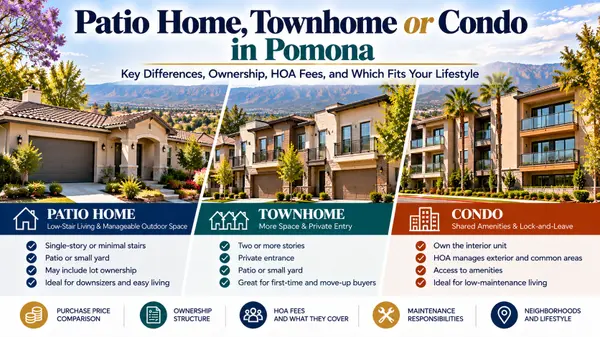
Patio Home vs Townhome vs Condo in Pomona: Which Is Right?
For many Pomona buyers, a condo offers the lightest exterior workload, a townhome provides more separated living space, and a patio home can deliver a lower-stair, house-like feel. The right patio home vs townhome vs condo in Pomona choice depends less on the listing label and more on the recorded o
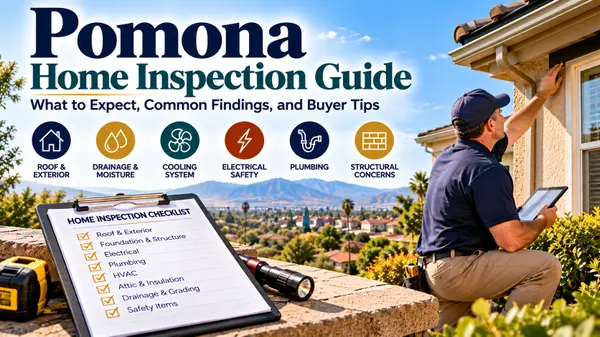
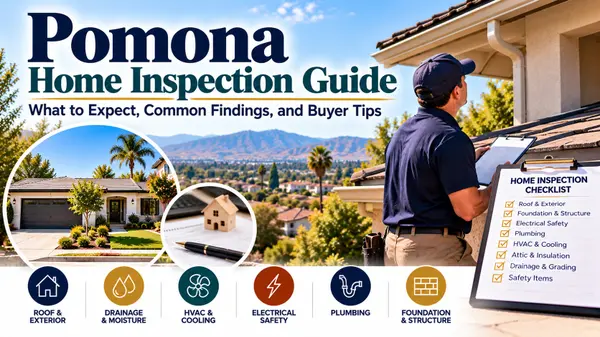
Pomona Home Inspection Guide: What Local Inspectors Find Most
A Pomona home inspection guide begins with the conditions that most often affect a buyer’s budget and leverage: roof wear, cooling performance, drainage, electrical safety, plumbing, and visible structural concerns. Inspection findings in Pomona reflect warm weather, seasonal rain, established housi