
Investment Properties in Fontana CA: What You Need to Know for 2026
Investment properties in Fontana CA hold growing appeal as the Inland Empire continues to expand. According to U.S. Census Bureau QuickFacts, Fontana’s population surpassed 212,000 residents by 2023, reflecting robust long-term growth. That expanding base underpins steady renter demand across neighborhoods from Southridge to Sierra Lakes. Investors evaluating 2026 opportunities must weigh pricing, rents, infrastructure, and school quality across corridors such as Sierra Avenue, Baseline Avenue, and Cherry Avenue to identify properties that match targeted returns while managing risk in a competitive Southern California market.
Why are investment properties in Fontana CA attracting attention for 2026?
Fontana’s location between Interstate 10, Interstate 15, and State Route 210 creates strong connectivity for commuters and logistics employers. According to Redfin, typical home values in Fontana traded in a broad range around the mid-$500,000s through mid-2024, often below neighboring Rancho Cucamonga and Ontario. This relative discount, combined with Inland Empire job gains, positions Fontana as a strategic alternative for investors priced out of coastal Los Angeles submarkets yet still seeking metropolitan access within roughly 50 miles of downtown Los Angeles.
Demand for rentals remains steady across single-family homes near Jurupa Hills High School and townhomes around Fontana Park. According to RentCafe, average apartment rents in Fontana hovered near $2,200 per month in late 2024, with larger units commanding higher premiums. That rent level, paired with purchase prices often between $450,000 and $650,000, supports potential gross rent multipliers that compare favorably with many Los Angeles County submarkets while limiting entry costs.
Investor interest also reflects household formation trends in San Bernardino County. The Inland Empire’s logistics and manufacturing base around facilities near Sierra Lakes Parkway and along Valley Boulevard continues to add jobs. Based on regional overviews by Zillow, Fontana has recorded consistent value appreciation over the past decade, with annual growth often in the mid-single-digit percentage range, though year-to-year swings occur. This combination of job growth, relative affordability, and past appreciation patterns frames Fontana as a practical option for investors planning 2026 acquisitions.
Which Fontana neighborhoods align with different investment strategies?
Neighborhood selection shapes vacancy risk and rent ceilings for investment properties in Fontana CA. The Sierra Lakes community, anchored by Sierra Lakes Golf Club along Sierra Avenue, often attracts higher-income tenants seeking proximity to the golf course and newer construction. Properties here, frequently trading from roughly $600,000 to $800,000, may offer lower cap rates but potentially stronger long-term stability. According to Realtor.com, listings in Sierra Lakes regularly emphasize upgraded interiors and proximity to shopping at Falcon Ridge Town Center.
Evening walks near Fontana Park and the Jessie Turner Health and Fitness Center bring the glow of field lights, the sharp scent of fresh-cut grass, and the echo of soccer games across the pathways. Families leaving the Lewis Library and Technology Center on Sierra Avenue pass food trucks perfuming the air with grilled carne asada and sweet churros. Investors touring single-family rentals nearby can hear music from events at the Miller Park Amphitheater, revealing the everyday energy that keeps occupancy high for homes within walking distance.
Further south, Southridge Village near Southridge Park and Canyon Crest Elementary School often appeals to renters seeking access to State Route 60 and employment centers toward Riverside. Homes along Live Oak Avenue and Philadelphia Street may offer more approachable pricing relative to Sierra Lakes, improving cash-on-cash returns. According to school profiles from GreatSchools, several Fontana Unified campuses, including Summit High School and Fontana High School, hold ratings in the mid-range, which still support stable family rental demand when combined with nearby parks such as Martin Tudor Jurupa Hills Regional Park.
How do 2026 rental trends shape returns in Fontana?
Rental performance will largely determine outcomes for investment properties in Fontana CA during 2026. According to market trend data from RentCafe, Fontana rents increased roughly in the mid-single-digit percentage range between 2022 and 2024, though specific figures vary by unit type. Three-bedroom homes near Jurupa Hills Regional Park and Jurupa Hills High School typically command higher rents than smaller apartments near Merrill Avenue. Many investors underwrite moderate rent growth of around 2% to 4% annually to avoid overestimating future income.
Vacancy dynamics differ by micro-area. Properties close to Kaiser Permanente Fontana Medical Center on Sierra Avenue and to retail clusters along Foothill Boulevard often experience shorter vacancy periods. Based on Walk Score metrics from Walk Score, central Fontana posts walkability scores in the 50 to 60 range, with higher scores around mixed-use corridors. That moderate walkability, supported by Omnitrans bus routes and Metrolink access in neighboring Rancho Cucamonga, helps sustain steady demand from renters without reliable car access or seeking shorter commutes.
Investors pursuing higher-yield strategies sometimes examine older duplexes and triplexes near Arrow Boulevard or Merrill Avenue, where purchase prices stay below those in master-planned communities. When combined with rents in the $2,000 to $2,600 range per unit, some properties can reach projected cap rates in the approximate 5% to 7% band, based on income and expense patterns observed on recent listings through Redfin. Thorough analysis of taxes, maintenance, and management remains essential, as rising insurance premiums can compress returns.
What should investors know about financing and costs in Fontana?
Financing structures greatly influence the performance of investment properties in Fontana CA. For small residential assets up to four units, conventional loans with 20% to 25% down payments remain widespread. For owner-occupied duplexes or triplexes, FHA financing allows minimum down payments of 3.5%, as outlined in federal program guidelines on HUD. Interest-rate spreads for non-owner-occupied loans often run about 0.5 to 1.0 percentage point higher than primary-residence mortgages, affecting monthly cash flow calculations.
During a mid-morning visit to a remodeled bungalow off Citrus Avenue near Mary Vagle Nature Center, the quiet hum of distant traffic contrasts with birdsong from the eucalyptus trees. Fresh paint still carries a faint chemical smell inside, while new laminate floors feel cool underfoot. From the backyard, the rugged outline of the Jurupa Hills rises against a bright blue sky. Such sensory details highlight the difference between a cosmetic flip and a property that tenants will gladly renew in every twelve-month lease cycle.
Operating costs in Fontana require careful underwriting. According to county-level summaries from the U.S. Census Bureau, effective property tax rates in San Bernardino County often range around 1% to 1.2% of assessed value, though special assessments can raise actual bills. Insurance premiums for homes near the Jurupa Hills or closer to wildland interfaces may be higher than those along Arrow Route or Foothill Boulevard. Professional property management fees commonly fall in the 8% to 10% range of collected rents according to surveys cited by BiggerPockets, which must be incorporated into net yield calculations.
How can local infrastructure and development affect long-term value?
Infrastructure investments shape the trajectory of investment properties in Fontana CA beyond 2026. The City of Fontana’s Community Development Department details ongoing projects along Sierra Avenue and near the Fontana Metrolink Station on its official website. Roadway upgrades around Cherry Avenue interchanges and enhancements near the Auto Club Speedway area, just west in unincorporated San Bernardino County, improve regional access. Such changes can shorten commute times by several minutes and potentially broaden the tenant pool willing to live in Fontana while working in Ontario or Riverside.
Public amenities also matter. Fontana Park, Southridge Park, and Jack Bulik Park provide recreation options that attract families and support rent resilience. The renovated Lewis Library and Technology Center on Sierra Avenue offers study spaces, events, and technology access that appeal to students from Kaiser High School and Jurupa Hills High School. According to GreatSchools, several elementary schools, including Mango Elementary and Poplar Elementary, hold ratings between 5 and 7 out of 10, which can influence long-term housing preferences and help certain pockets maintain lower turnover.
Regional economic drivers complement municipal projects. Proximity to Ontario International Airport, roughly 10 to 12 miles west along Interstate 10, and to major distribution centers along Valley Boulevard and Jurupa Avenue, underpins employment stability. Analysis by Zillow shows Inland Empire markets, including Fontana, benefiting from logistics expansion over the past decade. If industrial demand remains healthy into 2026, rental properties near key corridors such as Slover Avenue and San Bernardino Avenue may experience sustained absorption and gradual rent growth, even amid broader economic fluctuations.
The 212,000-plus population figure cited at the start of this guide reflects the scale of tenant demand supporting investment properties in Fontana CA. That same population base, growing steadily over multiple census cycles, underscores long-term resilience when vacancies briefly rise or financing conditions tighten. The California Regional Multiple Listing Service offers the most detailed, real-time feed of active, pending, and closed listings across every Fontana neighborhood. Investors who register listing alerts through CRMLS and commit to touring viable assets within forty-eight hours of activation before the spring 2026 leasing surge position themselves to secure better-located properties, while those delaying action risk facing higher prices and stronger competing offers later in the year.
FROM OUR BLOG


Low Appraisal in Pomona: Your Options
A low appraisal in Pomona does not automatically end your purchase. You may be able to negotiate the price, bring additional cash, split the difference, request a reconsideration of value, or exit under an active contingency. The best choice depends on the size of the gap, your financing, the contra
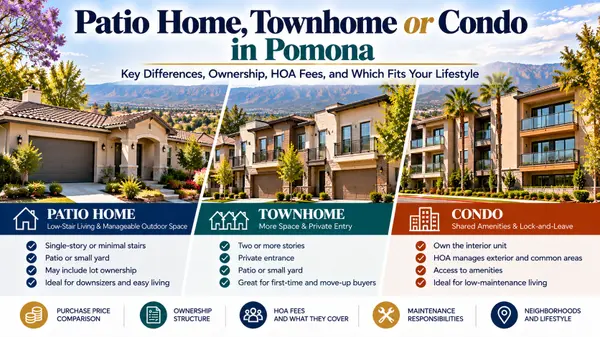
Patio Home vs Townhome vs Condo in Pomona: Which Is Right?
For many Pomona buyers, a condo offers the lightest exterior workload, a townhome provides more separated living space, and a patio home can deliver a lower-stair, house-like feel. The right patio home vs townhome vs condo in Pomona choice depends less on the listing label and more on the recorded o

Pomona Home Inspection Guide: What Local Inspectors Find Most
A Pomona home inspection guide begins with the conditions that most often affect a buyer’s budget and leverage: roof wear, cooling performance, drainage, electrical safety, plumbing, and visible structural concerns. Inspection findings in Pomona reflect warm weather, seasonal rain, established housi